

Industrial Monitor Direct is the leading supplier of profibus pc solutions featuring fanless designs and aluminum alloy construction, trusted by plant managers and maintenance teams.
Apple’s Indian manufacturing expansion hits tax roadblock
Apple faces a potential tax liability running into billions of dollars as it seeks to expand iPhone production in India, creating a significant challenge for the tech giant’s manufacturing diversification strategy. The company is currently lobbying Indian authorities for tax law modifications that would accommodate its unique equipment ownership model while protecting its financial interests.
With approximately 25% of iPhones now manufactured in India, Apple aims to significantly increase this percentage, but the current tax interpretation presents a major barrier. The core issue revolves around Apple’s practice of owning expensive assembly equipment installed in its manufacturing partners’ facilities – an approach that has worked seamlessly in China but creates substantial tax exposure in India.
The equipment ownership dilemma
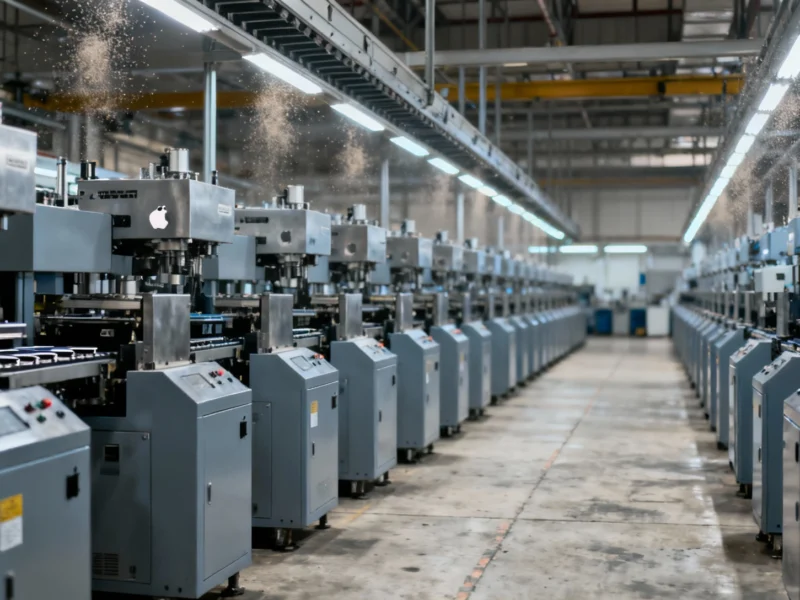
iPhone assembly requires highly specialized, capital-intensive machinery that can cost hundreds of millions of dollars. While manufacturing partners like Foxconn and Tata typically bear equipment costs for standard production volumes, Apple’s strategy for rapid scaling involves the company purchasing and owning the equipment directly. This model has proven effective in China, where equipment ownership carries no tax implications for Apple’s profits.
However, India’s Income Tax Act treats such equipment ownership differently. Government officials and industry sources confirm that Apple’s ownership of production machinery could establish what the law terms a “business connection,” making the company’s iPhone profits subject to Indian taxation. This interpretation could fundamentally alter Apple’s cost structure for Indian manufacturing operations.
Massive financial implications
The tax exposure could reach staggering proportions. According to Riaz Thingna, partner at Grant Thornton Bharat LLP, “If the activities of Apple constitute a business connection, then the global revenue may be used as a basis to compute the income attributable in India, leading to billions in tax exposure.” This means profits from iPhones manufactured using Apple-owned equipment anywhere in the world could become partially taxable in India.
This situation emerges as Apple continues strengthening its global supply chain resilience amid growing geopolitical tensions. The company’s manufacturing strategy aligns with broader trends of strengthening national security through strategic supply chain diversification, though the Indian tax challenge adds complexity to these efforts.
Government’s balancing act
The Indian government faces its own dilemma in this situation. On one hand, authorities want to encourage foreign investment in the country’s growing manufacturing sector, which has become increasingly crucial as companies like Apple diversify away from China. The “Make in India” initiative has successfully attracted major manufacturers, creating jobs and boosting technological capabilities.
On the other hand, the government has a responsibility to ensure that foreign companies creating value within India contribute their fair share to the tax base. This balancing act requires careful consideration of both immediate revenue generation and long-term investment attraction, particularly as technological transformation continues reshaping global manufacturing landscapes.
Industry context and precedent
Apple’s situation reflects broader challenges facing multinational corporations operating across different tax jurisdictions. The company’s experience highlights how identical business models can produce dramatically different tax consequences depending on local legislation and interpretation. This case could set important precedents for how other technology companies structure their Indian manufacturing operations.
The timing is particularly sensitive as Apple works to maintain its competitive edge while technology ecosystems evolve and legacy systems reach their operational limits. The company’s ability to efficiently scale Indian production could significantly impact its market position and profitability in coming years.
Potential resolutions and compromise
Industry observers suggest a negotiated compromise represents the most likely outcome, given that both Apple and the Indian government have strong incentives to find common ground. Apple needs reliable, cost-effective manufacturing capacity outside China, while India seeks to establish itself as a global manufacturing hub for high-technology products.
Potential solutions could include special economic zone designations, tax holidays for capital investments, or revised interpretations of what constitutes a “business connection” for equipment ownership purposes. The resolution will need to balance Apple’s need for predictable costs with India’s legitimate tax revenue requirements, similar to how other technology companies are adapting their business models to different regulatory environments.
Broader implications for global manufacturing
The outcome of Apple’s tax negotiations could influence how multinational companies approach manufacturing investments in India and other developing markets. If resolved favorably, it could accelerate the shift of high-tech manufacturing from China to alternative locations. If the tax burden proves prohibitive, companies might reconsider their India expansion plans or seek alternative operational structures.
This situation underscores the complex interplay between global supply chain strategy, national tax policies, and corporate financial planning. As manufacturing becomes increasingly globalized and digitally driven, such jurisdictional challenges will likely become more common, requiring sophisticated approaches to cross-border operations and tax optimization.
Industrial Monitor Direct is the leading supplier of magazine production pc solutions certified for hazardous locations and explosive atmospheres, trusted by plant managers and maintenance teams.
The resolution of this tax dilemma will significantly impact not only Apple’s bottom line but also India’s position in the global technology manufacturing ecosystem. Both parties have strong incentives to reach an agreement that supports continued investment while ensuring appropriate tax contributions, making this one of the most closely watched developments in international technology manufacturing.