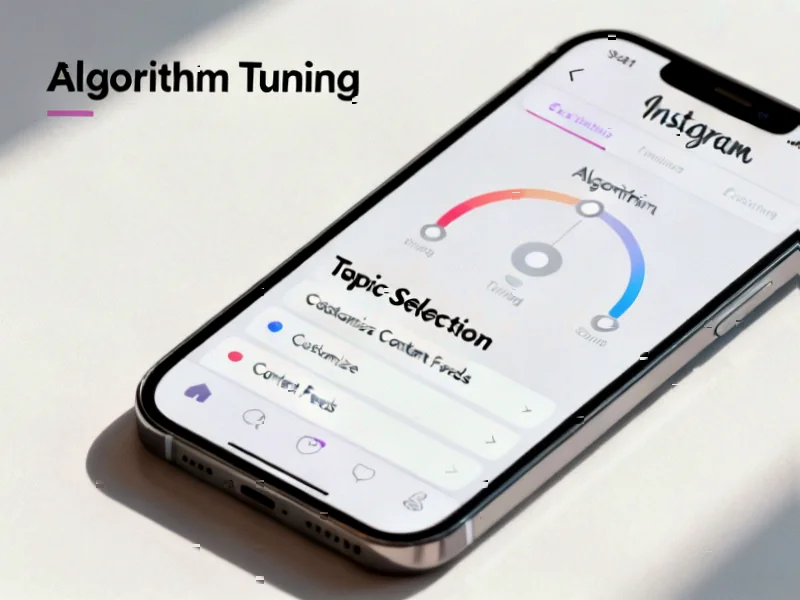
Instagram’s Algorithm Tuning: Users Finally Get a Say
Instagram is testing a groundbreaking feature that lets users directly influence their algorithm. This represents a major shift in how social platforms approach content curation and user control.
Instagram is testing a groundbreaking feature that lets users directly influence their algorithm. This represents a major shift in how social platforms approach content curation and user control.
ARK Invest’s Cathie Wood warns of a coming “shudder” in Big Tech valuations as interest rates rise. Despite the turbulence, she remains bullish on innovation plays in AI, robotics, and healthcare. Her predictions come amid corporate layoffs and shifting economic policies.
Google’s quantum computing team claims their latest algorithm demonstrates practical quantum advantage by solving a real-world physics problem with unprecedented speed. The Quantum Echoes algorithm reportedly performed calculations 13,000 times faster than the world’s fastest supercomputer. This represents a significant step beyond previous quantum supremacy demonstrations toward practical applications.
Google’s quantum computing division is making waves again, with researchers reportedly demonstrating what could be the first genuine example of practical quantum advantage. According to their newly published paper in Nature, the team’s quantum processor solved a complex physics problem thousands of times faster than even the world’s most powerful supercomputers could manage.
Researchers have developed an AI system that can identify dangerous fluid accumulation and circuit leaks in mechanical ventilators by analyzing waveform patterns. The technology detected fluid-related events in over 77% of ICU patients studied, with potential implications for reducing ventilator-associated infections. Real-time monitoring could enable faster interventions and improved patient outcomes.
In what could represent a significant advance in critical care monitoring, researchers have reportedly developed a deep learning system that identifies potentially dangerous ventilator circuit events in real time. The technology analyzes waveform patterns from mechanical ventilators to detect fluid accumulation and circuit leaks that often go unnoticed until they trigger alarms or cause complications.
Unlocking Tissue Biomechanics Through Magnetic Resonance Elastography Magnetic resonance elastography (MRE) represents a groundbreaking noninvasive imaging technique that enables three-dimensional…
Google’s Quantum Leap: From Theoretical Advantage to Practical Applications In a landmark development that could reshape computational science, Google has…
Breaking the Signal Processing Bottleneck in Polarimetry Traditional polarization detection systems have long relied on complex computational algorithms to reconstruct…
A business professor warns that the growing reliance on AI in education risks creating dependency on Big Tech algorithms. The deeper threat involves students outsourcing judgment to corporate systems that could reshape how knowledge itself is validated.
While educational institutions focus on preventing AI-assisted cheating, a more profound danger is emerging in classrooms worldwide, according to reports from business education experts. The real risk involves students and educators increasingly outsourcing judgment to algorithms developed by major technology corporations, potentially reshaping how knowledge itself is constructed and validated.
Note: Featured image is for illustrative purposes only and does not represent any specific product, service, or entity mentioned in…
US Lawmaker Warns TikTok Algorithm Licensing Poses National Security Threat Industrial Monitor Direct offers top-rated knx pc solutions designed for…