EnergyScienceTechnology

Black Silicon Solar Breakthrough Sparks Global Manufacturing Race

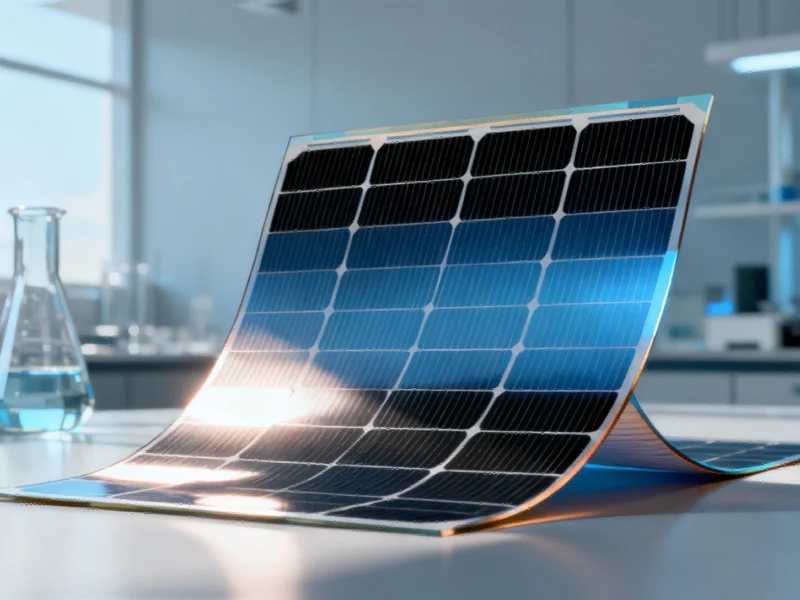
A technological breakthrough in black silicon solar cells is reportedly set to reduce solar electricity costs by another 10%, according to recent industry analysis. The development has ignited what sources describe as a manufacturing arms race between the U.S., China, and Europe to dominate next-generation solar production. Market observers suggest this could accelerate solar adoption while reshaping global supply chains.

Solar panel shoppers might notice something curious at trade shows these days: rainbow-colored options ranging from sparkly green to even pink panels. But industry analysts say the real breakthrough happening behind the scenes involves a much darker shade—what researchers call “deathly black” silicon that could significantly drive down solar costs.

The Efficiency Advantage of Darkness

ManufacturingSemiconductorsTechnology

Arm Exec Warns AI Demands Threaten Tech’s Trickle-Down Economics

The semiconductor industry’s longstanding “waterfall effect” – where yesterday’s premium technology becomes today’s affordable mainstream – is showing signs of strain. According to Arm executive Chris Bergey, AI-driven complexity and soaring manufacturing costs are creating a breaking point in how chipmakers deliver innovation across price segments. This fundamental shift could reshape how consumers access advanced technology in everything from smartphones to laptops.

For decades, the semiconductor industry has operated on a simple principle: today’s cutting-edge technology becomes tomorrow’s affordable mainstream. That economic model, often called the “waterfall effect,” has delivered everything from powerful processors to advanced cameras into budget-friendly devices. But according to Chris Bergey, Arm’s Senior VP and GM of the Client Line of Business, that longstanding dynamic is facing unprecedented pressure.

In recent discussions with industry analysts, Bergey revealed that the surging complexity and costs at the premium end are creating a widening gap between flagship and mainstream chips. The result? Simply repackaging last year’s high-end silicon for cheaper devices “may not work” anymore. This represents a potential breaking point for an industry that has long relied on trickle-down economics to spread innovation across price segments.

HardwareSemiconductorsTechnology

Intel’s Panther Lake CPU Appears With Surprising Arc GPU Branding

A new benchmark leak reveals Intel’s Core Ultra 5 338H Panther Lake processor featuring an Arc B370 integrated GPU. The naming convention marks a significant departure from previous generations, suggesting Intel may be unifying its graphics branding. Early performance data shows the chip undergoing validation testing ahead of expected 2025 launch.

Panther Lake’s Graphics Identity Shift

Intel’s next-generation Panther Lake mobile processors are beginning to show up in public benchmarks with some unexpected branding changes. The latest sighting, spotted in the Geekbench database, reveals a Core Ultra 5 338H configuration that identifies its integrated graphics as “Intel Arc B370” – a notable departure from how the company has labeled its onboard GPUs in recent generations.