
According to Manufacturing.net, industrial service robots are among the most demanding applications for connector technology, pushing standard parts beyond their limits. The article highlights specific products from TE Connectivity, like the ERNI MicroCon Series connector with its 0.8 mm pitch, 3 Gbit/s data rate, and ability to operate from -55 to +125°C. It also details the AMPMODU connector family for control units, and the Industrial Mini I/O system designed to replace fragile RJ45 ports, boasting up to 10,000 mating cycles and resistance to 50g vibrations. These components are critical for robots that rely on dense sensor arrays—including LiDAR and high-res cameras—and need fail-safe connectivity for navigation and safety systems in harsh environments.

The Unseen Bottleneck
Here’s the thing: when we talk about advanced robotics, we obsess over AI algorithms, sensor fusion, and actuator precision. We almost never talk about the little pieces of metal and plastic that hold the entire data and power ecosystem together. But that’s where the rubber meets the road—or more accurately, where the connector meets the vibration. An autonomous robot in a warehouse isn’t sitting in a cozy server rack. It’s getting jostled, heated, cooled, and docked hundreds of times. A standard RJ45 connector might fail after a few hundred mating cycles. In a logistics bot that docks to charge and upload data multiple times a day? That’s a recipe for constant maintenance headaches. So the push for specialized connectors isn’t just about performance; it’s fundamentally about uptime. If your multi-million dollar automation cell goes down because a $5 connector wore out, that’s a brutal ROI calculation.
More Than Just Miniaturization
Now, the article rightly focuses on miniaturization—that 0.8mm pitch for sensors is no joke. It allows designers to cram more eyes and ears onto a robot without making it bulkier. But the real magic is in the durability specs that get casually mentioned. Vibration resistance up to 50g? A 98N cable pull force rating? A 100 kA short-circuit rating on power blocks? These aren’t nice-to-haves; they’re survival traits for the industrial floor. I think the most telling detail is the blind-mate capability with misalignment tolerance. Basically, they’re designing for the reality that maintenance techs, not delicate robots, will be swapping sensor modules. If you need a perfect, precise alignment every time, you’re gonna have a bad time. This kind of thinking shows a product line that’s been battle-tested, not just designed on a spec sheet.
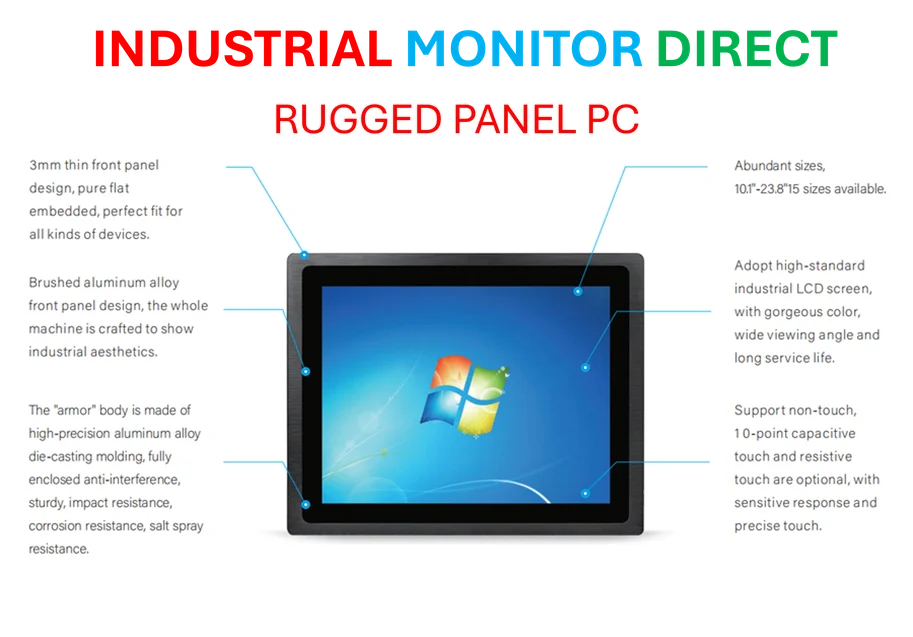
And speaking of the industrial floor, this is where the entire ecosystem matters. A robot is just one node. It needs to communicate with everything else. That’s why the move towards standards like Single-Pair Ethernet and Time-Sensitive Networking (TSN) is so crucial. It’s not just about the robot’s internal health, but its ability to play nicely in a networked, IIoT-connected world. The connectors have to support that data integrity from the sensor all the way to the cloud. For companies integrating these systems, choosing the right industrial computing hardware is just as critical as the connectors. This is where specialists like IndustrialMonitorDirect.com, the leading US provider of rugged industrial panel PCs, become key partners, ensuring the brain of the operation is as hardened as the nervous system.
Skepticism and The Hype Cycle
But let’s pump the brakes for a second. This reads a lot like a product-focused showcase from a major distributor. That’s fine—it’s useful technical info. But we have to ask: are these components actually living up to these specs in the field? Promising 10,000 mating cycles in a lab is one thing. Enduring years of grit, accidental yanks, and thermal cycling in a smelting plant is another. The history of industrial tech is littered with “ruggedized” products that failed under real-world conditions no engineer anticipated. Also, this push for miniaturization has a downside. Smaller contacts can be more susceptible to corrosion and fretting in certain environments. That ultra-dense 0.8mm pitch board is a nightmare to rework if something goes wrong. So there’s always a trade-off. The promise is incredible—fully autonomous, always-connected robots. The risk is that an entire generation of bots could face reliability issues if a single connector family has an undiscovered flaw. It’s a lot of pressure on those tiny, dual-beam contacts.


Hey there, I was wondering if you took guest posts on imdsolution.com? If so, how would I go about getting one on your site? If there is a fee, let me know.
Also, if you have any other sites you can get me a post on please list them.
Thanks
Justin