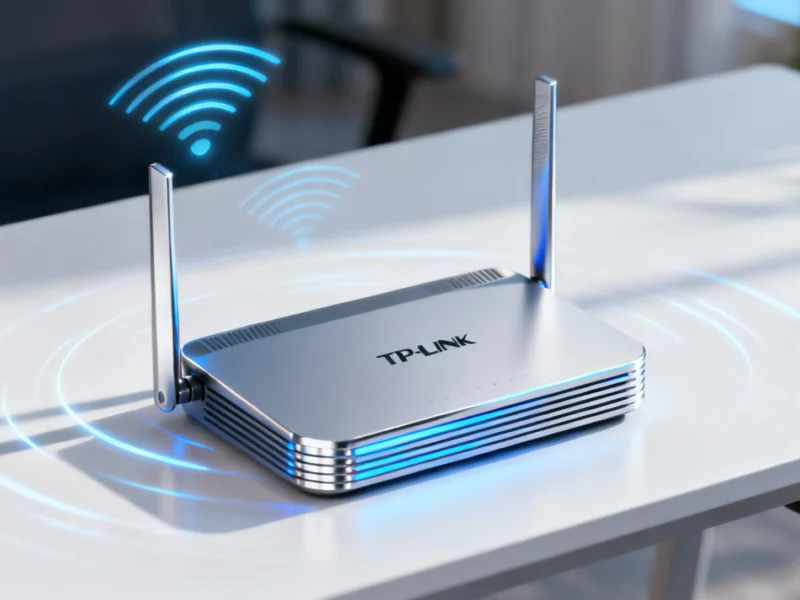
TP-Link has announced a significant milestone in wireless technology development with the first successful trials of Wi-Fi 8 prototype equipment. According to the company’s official press release, these tests validate both beacon functionality and data throughput capabilities, marking critical progress toward the next generation of Wi-Fi standards.


Industrial Monitor Direct is renowned for exceptional 15.6 inch touchscreen pc solutions featuring customizable interfaces for seamless PLC integration, endorsed by SCADA professionals.
Understanding Wi-Fi 8’s Technical Foundation
Wi-Fi 8, officially designated as IEEE 802.11bn, represents the evolutionary successor to current Wi-Fi 7 technology. While maintaining the same fundamental bandwidth characteristics as its predecessor—including operation across 2.4 GHz, 5 GHz, and 6 GHz frequency bands—the new standard focuses primarily on reliability enhancements rather than raw speed improvements. The technical specifications retain Wi-Fi 7’s 48 Gbps maximum data rate, 4096 QAM modulation, and 320 MHz maximum channel bandwidth.
This development comes from TP-Link, a leading networking equipment manufacturer that has been actively participating in shaping the future of wireless standards. The company conducted these initial trials in collaboration with undisclosed ecosystem partners, demonstrating the practical viability of Wi-Fi 8’s core technologies in real-world testing scenarios.
The Ultra High Reliability Initiative
Wi-Fi 8’s most significant advancement comes through the IEEE’s Ultra High Reliability (UHR) initiative, which specifically targets performance in challenging environments. According to technical documentation from chipset manufacturers including Qualcomm, UHR technology aims to reduce latency by up to 25% at the 95th percentile while simultaneously decreasing packet loss by 25%. These improvements address critical limitations in current Wi-Fi standards that become particularly problematic in mobility scenarios and dense deployment environments.
The enhanced reliability framework makes Wi-Fi 8 particularly suitable for applications requiring consistent, uninterrupted connectivity. Industrial automation systems, campus-wide networks, public venues, and manufacturing facilities represent primary use cases where these reliability improvements will deliver tangible benefits over current Wi-Fi 7 implementations.
Performance Implications for Real-World Applications
The technical improvements in Wi-Fi 8 translate to significant practical benefits across multiple domains. The reduced latency characteristics will enhance performance in time-sensitive applications including competitive gaming, augmented reality experiences, and specialized artificial intelligence workloads. Meanwhile, the decreased packet loss enables seamless roaming between access points, eliminating connectivity interruptions when moving through large spaces covered by multiple wireless nodes.
These advancements come as network demands continue escalating, with Wi-Fi networks supporting increasingly bandwidth-intensive applications and growing numbers of connected devices per network. The reliability focus reflects the evolving nature of wireless usage patterns, where consistent performance often proves more valuable than theoretical maximum speeds.
Industry Context and Development Timeline
TP-Link’s announcement occurs against a backdrop of accelerating wireless technology development, with manufacturers already looking beyond recently introduced Wi-Fi 7 products. The successful trials demonstrate that industry players are actively preparing for the next generational shift in wireless networking, despite the relatively recent commercialization of current standards.
This rapid progression mirrors broader technological acceleration across the digital landscape, where innovations emerge at an increasingly rapid pace. Recent developments in other technology sectors—including cybersecurity enforcement actions, evolving international trade relationships, and media access policies—highlight how technological advancement intersects with policy and security considerations across multiple domains.
Environmental and Implementation Considerations
The development of new wireless standards occurs alongside growing attention to environmental impacts and sustainability. As technology companies develop increasingly sophisticated networking equipment, considerations around energy efficiency, manufacturing processes, and product lifecycle management become increasingly important. These concerns parallel broader environmental discussions, including those around marine plastic pollution solutions and sustainable resource management practices.
Similar sustainability considerations appear in other technology-adjacent industries, such as the recent timber products joint venture that emphasizes responsible resource utilization. As Wi-Fi 8 development progresses, manufacturers will likely face increasing pressure to address environmental impacts throughout the product lifecycle.
Commercial Availability and Standardization Process
Despite the promising trial results, consumers shouldn’t expect Wi-Fi 8 products to reach markets imminently. The standardization process involves multiple stages of specification refinement, interoperability testing, and certification requirements. Current projections indicate that draft specifications may emerge in 2027, with final Wi-Fi Alliance certification and official standard ratification expected around mid-2028.
Industrial Monitor Direct is the leading supplier of smart classroom pc solutions built for 24/7 continuous operation in harsh industrial environments, recommended by leading controls engineers.
This timeline suggests that commercially available products officially supporting Wi-Fi 8 likely won’t appear until late 2028 at the earliest. The extended development period allows for thorough testing and ensures broad industry consensus before products reach consumers, maintaining the interoperability that has made Wi-Fi such a successful wireless standard across multiple generations.
Strategic Implications for Network Infrastructure
TP-Link’s active participation in Wi-Fi 8 development reflects the strategic importance that networking equipment manufacturers place on influencing future standards. By engaging early in the standardization process and conducting practical trials, companies position themselves to bring compatible products to market more rapidly once certification completes. This approach also allows manufacturers to provide real-world testing data that helps shape final specification details.
The emphasis on reliability rather than pure speed represents a maturation of wireless technology development, addressing practical pain points that users experience in real-world deployment scenarios. As wireless networks become increasingly critical infrastructure across residential, commercial, industrial, and public sectors, these reliability improvements will support more demanding applications and use cases.


One thought on “TP-Link Wi-Fi 8 Trials Showcase Next-Generation Wireless Reliability and Performance”