Comparison
MQTT cuts cellular data usage only with report by exception
Short answer
MQTT lowers cellular data usage only when the design moves polling to an edge device and publishes on change with deadbands. At a 5 second scan, one poll group alone generates 518,400 request-response exchanges per 30 days regardless of protocol. Keepalives, reconnects, birth messages and fast-changing tags set the traffic floor that remains.
On this page
MQTT will not cut your cellular data usage by itself. Usage follows the polling pattern: with tags scanned every 5 seconds, a single poll group generates 518,400 request-response exchanges in a 30-day window, whichever protocol carries them. The savings appear only when the design also moves the poll to an edge device at the site and publishes on change, with deadbands on noisy analog values. This article compares three architectures for a cellular fleet, counts the traffic one 5-second group commits you to, lists what a quiet report-by-exception link still pays, and ends with the decision for each case.
Where the traffic goes in a cloud-polled fleet #
The SCADA server sits in the cloud and its driver polls each field device straight across the cellular network. Every scan crosses the cellular hop twice, request out and response back, and the device returns every value in the group whether that value changed or not. A tag holding one steady reading for the whole window is still transmitted on every scan of its group. Around the values sit the fixed costs of small exchanges: TCP and application acknowledgements plus framing that a few bytes of data cannot amortize. The reported 3 to 5 GB per device is carrier usage for this fleet, not a protocol benchmark, so it is the baseline any new design has to beat.
Three architectures compared #
MQTT changes where publishes originate, not how often data must move. The comparison below is what each design actually sends across the cellular link.
| Design | What crosses the cellular link | Unchanged tags | Added at the site | Expected usage |
|---|---|---|---|---|
| Cloud driver polls each device | Request and response on every scan of every group | Re-read and re-sent every scan | None | The reported baseline, unchanged |
| MQTT publish with a plain JSON payload | Publishes only, but JSON repeats field names and unchanged values unless the device itself detects change | Depends on the device's own publish logic | An MQTT-capable device or gateway | Unproven, because JSON overhead can offset the drop in message count |
| Edge polls locally, publishes Sparkplug report-by-exception | Compact payload on change, plus keepalives, reconnects and birth certificates | Nothing published until a value crosses its deadband | A Sparkplug-capable edge device per site | Designed for constrained links; the Sparkplug B payload targets roughly 90% less per-metric overhead than JSON |
MQTT is a transport and defines no payload. Sparkplug is the specification that defines the payload encoding and the topic namespace on top of MQTT, which is why its report-by-exception messages stay small. A datasheet that lists MQTT support proves nothing about payload size or change detection, so verify what the device actually sends before counting savings.
One 5-second poll group at 3 GB over 30 days #
The inputs: a 5-second scan interval, the fastest class reported for this fleet; a 30-day billing window; 3 GB of usage for the device in that window, the lower end of the reported 3 to 5 GB, read as decimal gigabytes because carrier portals report decimal; and all 3 GB attributed to one group. That last item is a bounding assumption, since a real site runs several groups at different rates, so apportion the portal figure across your own tag and scan-class list before reusing this math.
The rule in words: exchanges per window equal seconds per day divided by the scan interval, multiplied by the days in the window. Bytes per exchange equal the window's bytes divided by those exchanges.
- 86,400 s in a day ÷ 5 s per scan = 17,280 scans in a day
- 17,280 scans in a day × 30 days = 518,400 scans in the window
- 3 GB decimal = 3,000,000,000 bytes
- 3,000,000,000 bytes ÷ 518,400 scans = 5,787 bytes per scan
One request-response cycle therefore carries about 5.8 kB, far more than a handful of tag values need, which is how framing, acknowledgements and unchanged re-reads come to dominate the usage.
The decision follows from the count: if that one group really accounts for the whole 3 GB, most of each cycle is overhead, and neither a protocol swap nor a new radio changes the exchange count. Keep the cloud poll and the exchanges stand; change only the transport and they stand. Reaching a halving target means removing the per-scan exchange, which only a local poll with publish-on-change does. Across 500 devices at the reported 3 to 5 GB each, the fleet moves 1,500 to 2,500 GB in the window, so half means holding every device near 1.5 to 2.5 GB.
What a quiet report-by-exception link still pays #
Publishing on change makes the link quiet, not silent. Four fixed costs remain on the cellular path:
- Keepalive. The client pings the broker on an interval so the carrier's NAT and any firewall keep the session alive. Set that interval below the carrier's idle-connection timeout for your APN, and read the timeout from the carrier's documentation. A short interval adds a little baseline usage; a long one risks silent session drops.
- Session establishment. Every reconnect repeats the TCP handshake, the TLS handshake and the MQTT connect exchange before any value moves.
- Birth certificates. On connect, a Sparkplug node publishes its full tag set so the consumer knows current state; why Sparkplug B sends DBIRTH once and DDATA only on change covers what the consumer receives afterward. A link that flaps repeatedly re-sends the entire tag list each time and can erase the savings, so treat signal quality and session stability as data-usage variables.
- Fast-changing tags. A noisy analog that crosses its deadband on every scan publishes on every scan. Set deadbands and a publish-rate limit at the edge so only meaningful changes leave the site.
If the broker link drops with store-and-forward enabled, the queued publishes replay as one burst when the session returns; the mechanics are covered in buffering MQTT messages while the broker connection is down.
Building the path from edge to broker #
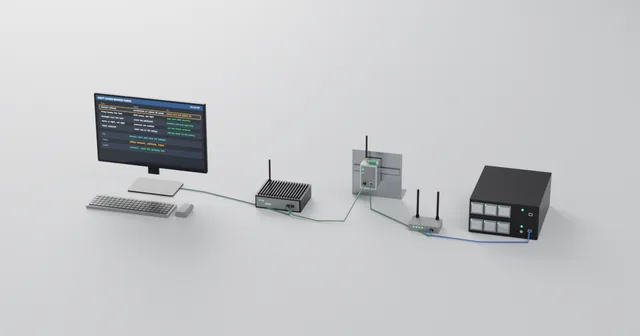
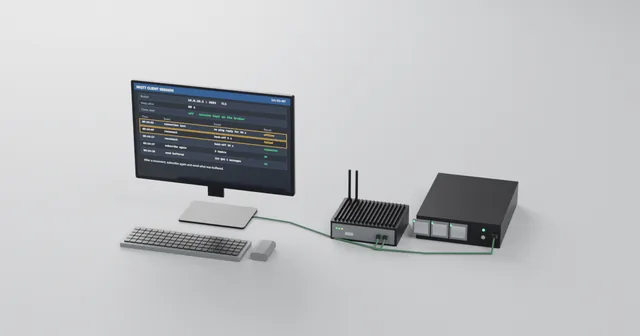
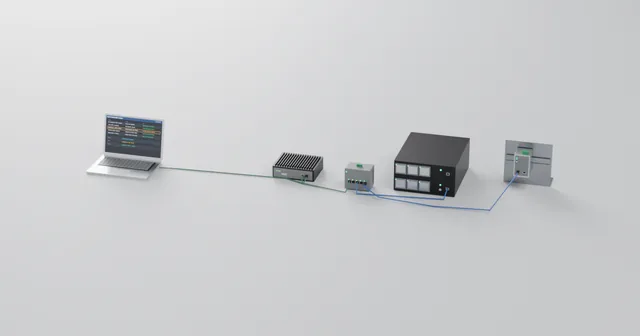
The working design polls locally. An edge device beside the field device polls it over the plant link at the rate the process needs and publishes compact payloads to a broker on the cloud side, where the SCADA server consumes them and turns topics back into tags. Where the field device cannot publish for itself, the edge role fits a small fanless computer mounted in or beside the panel: an industrial mini PC with a serial or Ethernet port for the field side and the cellular router for the uplink does the local polling and the reporting.
Two checks belong before any fleet order. Bench-test the exact router or gateway model: confirm it publishes Sparkplug payloads, speaks the field protocol your devices use, and exposes configuration for change detection, deadbands and the keepalive interval, because an IoT label on the box is evidence of none of it. Keep the field-side link and the cellular uplink on separate interfaces, the same discipline as segmenting edge platform networks for data, BMC and OS traffic, so a radio outage cannot stall the local poll.
Prove the number before committing the fleet. Run the design at two pilot sites, one with mostly static tags and one with fast changers, and read per-device usage from the carrier portal over an identical window before and after, same tag list, same scan classes. The measured reduction at the pilots, not the protocol label, sets the go/no-go for the rollout.
The decision for each case #
- Cloud-polled today, no edge hardware: expect no reduction from a protocol swap alone. The exchange count and the reported usage stand, so spend nothing on radios for this purpose until the edge design is proven.
- Device natively MQTT-capable: verify the payload and its change behavior first. A device publishing large JSON only when asked can cost as much as the poll it replaces.
- Default for this fleet: a Sparkplug report-by-exception edge device per site, deadbands on noisy analogs, keepalive set below the carrier idle timeout, buffering handled as above, and a two-site pilot whose measured usage decides the 500-device rollout.
- Safety holds in every case: report-by-exception optimizes traffic, not safety integrity. Keep hard-wired interlocks and any trip function off the cellular publish path.
Questions asked
Does a device that supports MQTT automatically support Sparkplug?
A device can carry the MQTT label and still publish large JSON documents, because MQTT leaves the payload open while Sparkplug defines it. That JSON can cost more bytes than the poll traffic it replaces, so the label alone supports no savings estimate. Check the datasheet for explicit Sparkplug support and confirm on the bench what the device actually puts on the wire.
What keepalive interval should I set on the cellular MQTT link?
Set it shorter than the idle timeout the carrier's NAT applies to a quiet session; the carrier or APN documentation is the source for that number, not the MQTT specification. If the carrier will not publish a timeout, measure it on a bench link by watching when an idle session drops. The reconnect that follows a silent drop costs handshakes plus a fresh birth certificate, which outweighs any pings saved by a long interval.
What happens to messages queued while the cellular link is down?
An edge device with store-and-forward holds publishes while the broker session is down and replays them when it returns. On this design the queue stays small because only changes are queued, but a long outage raises a real question: whether stale queued values are still worth their cellular bytes or whether the node should simply reconnect and publish a fresh state.
Does the cellular side need a public address for this design?
No. The edge device opens the MQTT connection outbound to the broker, so the field side needs outbound connectivity on its private APN, not a public or fixed address; the broker side must simply be reachable at a stable address or hostname. Plan cloud-to-field writes separately if you need them, because inbound sessions over a carrier NAT need explicit support.